Practical guide
Understanding your billing workflow and responsibilities
Map the financial work before evaluating the interface
Optometry billing involves several connected records: the encounter, the claim, the payer response, the patient balance and the payments or adjustments recorded against them. A useful evaluation follows the movement between those records and identifies who is responsible at each stage. It should not begin and end with a screen showing a completed claim.
Write the practice's current process in plain language. Identify what the clinician supplies, what the billing team reviews, which work involves an outside service and how unresolved questions return to the practice. Include the financial review that happens after a response arrives. This makes dependencies visible before you compare software features.
Jelo provides billing records and workflows within the platform, while insurance and payer services are handled through Jelo AI. The exact accounts, payer requirements and operating responsibilities for your practice should be confirmed during setup. This guide explains how to evaluate those handoffs without promising coverage or reimbursement.
Keep the encounter as the source of the service
The billing workflow should reflect the care and services actually documented. The clinician and qualified billing team need to review the relevant information and resolve uncertainty through the practice's approved process. A template, a suggested code or a prefilled field does not establish that a service occurred.
Define what makes an encounter ready for billing review and who receives a request for clarification. If documentation needs correction, the responsible professional should review it. Administrative staff should not invent a clinical detail to move a claim forward or choose a service solely because a payment appears more favorable.
Use the billing and coding guide for a deeper discussion of the documentation handoff. This page focuses on the operational and financial sequence after the relevant record is available. Payer-specific and coding decisions need the appropriate qualified review and current source information.
Separate coverage information from payment certainty
Coverage and benefit information can help the practice prepare, but it should not be presented as a guarantee that a particular claim will be paid. The relevant service, documentation, enrollment and payer requirements still matter. Staff should understand the status and source of the information they are using.
Before relying on an electronic workflow, confirm the practice's payer and account prerequisites. Name the actual payers and arrangements in the evaluation rather than accepting a broad statement that insurance is supported. If a requirement remains unanswered, keep it visible until a specific response is available.
When discussing an amount with a patient, distinguish confirmed information from an estimate or unresolved question according to the practice's procedure. The software review should show where staff find the information and who resolves uncertainty. It should not turn a general eligibility result into a universal promise about the final balance.
Understand the confirmed Jelo AI arrangement
Jelo's owner confirms that insurance and payer work is handled through Jelo AI. The service charge is 10% of insurance reimbursements received, separate from the platform subscription. The AI biller launched in August 2026 and is available in beta with no usage cap during beta; future usage caps are planned.
No usage cap does not waive the reimbursement-based fee. Keep the service's availability, usage policy and pricing basis as separate facts in your evaluation. If your practice needs the precise treatment of a particular payment, adjustment or reversal, request that commercial detail rather than assuming the answer from the percentage alone.
The AI biller page provides a focused setup guide. Ask who supplies information, how questions reach the practice and how unresolved work is reviewed. The confirmed relationship does not establish universal payer coverage, autonomous appeals or a guaranteed financial outcome.
Define a claim-ready handoff
A claim-ready handoff should have an agreed meaning within the practice. Identify the documentation, patient and payer information that the responsible team needs to review. Decide who can mark the work ready and what happens when a required item is missing or inconsistent.
Use a fictional example to follow the handoff from the encounter into the billing workflow. Ask the receiving employee to explain which source record they use and what they would do with an unresolved question. This tests the team's ability to work from the record rather than relying on a presenter to narrate the missing context.
Keep the operational status separate from any assurance of acceptance or payment. Ready for review, prepared for submission and paid are different stages. Clear names and ownership help staff understand the next action and make later reporting more accurate.
Use worklists as a starting point for action
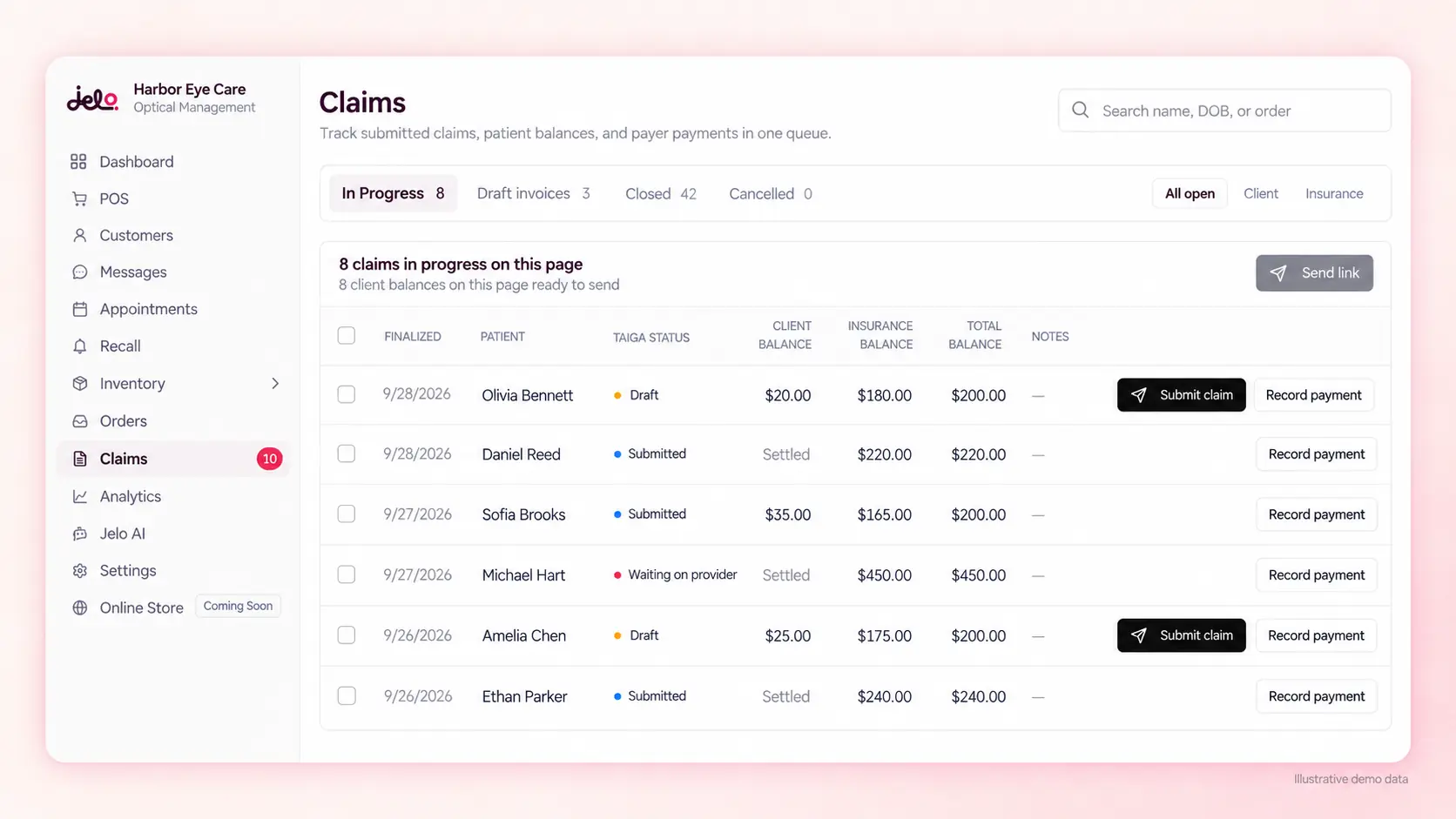
Jelo's claims worklists include drafts, in-progress, closed and cancelled work. Review status and balance filters before selecting an item so the team understands the population it is looking at. A filtered list is useful when staff know why each item belongs there and what responsibility follows.
Define how your practice handles an item that cannot proceed. Record the source reason, the next owner and the next review point in the approved workflow. A broad status such as in progress may be appropriate for grouping work, but the person responsible still needs to know what is actually waiting.
During the demo, ask to find a draft, an unresolved item and a closed example. Have the billing employee explain the evidence behind each state. The goal is an actionable review process, not a large queue whose age increases because nobody can identify the next step.
Preserve the source of a payer response
When a response arrives, the team needs to know what it refers to and where the authoritative information can be reviewed. Keep a usable source reference with the work. A paraphrased note can help summarize the issue, but it should not replace the original information needed for a qualified decision.
Separate the response category from the action the practice will take. A request for information, a rejection and a payment-related adjustment may require different handling. The responsible billing professional should determine the appropriate next step using the actual response and applicable payer requirements.
The claim follow-up guide provides a repeatable queue structure. Use the downloadable checklist for process coordination without copying patient details into an unapproved general spreadsheet. The source record should remain available in the practice's approved environment.
Distinguish payment from adjustment
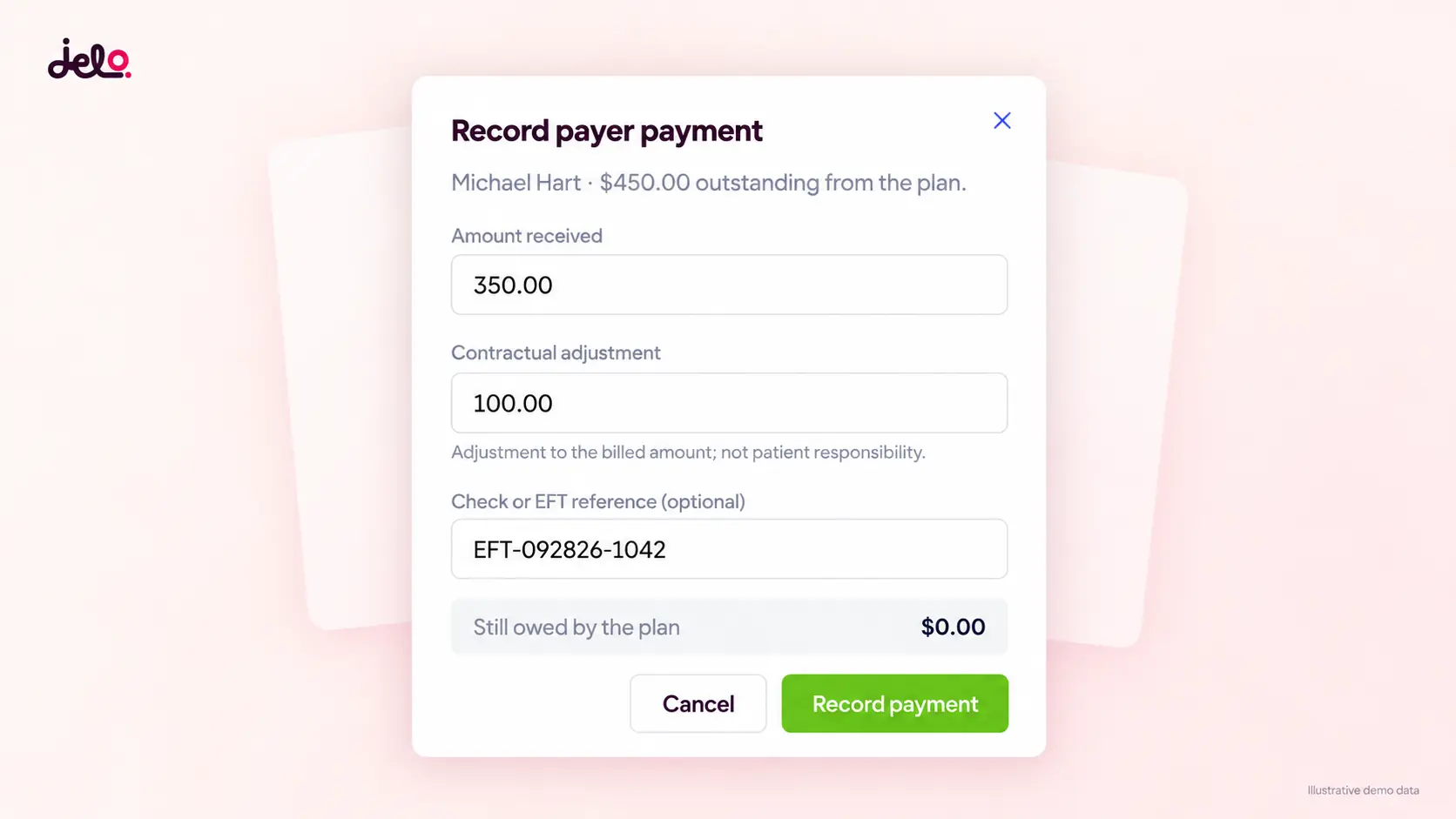
Jelo's payer-remittance form records payment and contractual adjustment separately, with a reference and a remaining payer balance. Staff should use the amounts from the actual remittance and review any suggested adjustment before recording it. An adjustment is not money received.
Consider a purely illustrative financial example: a record begins with $200, a payment is $120 and an applicable reviewed adjustment is $50. The arithmetic leaves $30 before any other relevant item. That does not determine who owes the remaining amount or whether the adjustment is appropriate; those decisions require the actual response and qualified review.
Keeping these amounts separate makes the financial record easier to explain. Combining an adjustment with payment can overstate collections and obscure unresolved work. In the acceptance test, ask the employee to identify each amount, its source and the evidence supporting the remaining balance.
Reconcile the response with the intended record
Before posting or closing financial work, confirm that the response matches the intended claim and related record. Similar amounts or nearby dates are not sufficient evidence on their own. Follow the practice's identification and reconciliation procedure, using the appropriate source references.
Review the payment, adjustment and remaining balance together. If something does not match, preserve the discrepancy and assign the next action rather than changing a number merely to make the record balance. A mismatch can reflect timing, an incomplete response or a record requiring further review.
Use a fictional remittance example during evaluation and ask the billing owner to explain the sequence. The sample interface above shows a form state, not a claim that was submitted or a payment posted. Your acceptance test should establish the supported workflow without creating a real financial transaction.
Give unresolved balances a reason and an owner
A remaining balance is a starting point for investigation, not a complete explanation of what should happen next. The team needs to know whether the item is waiting for information, a payer response, a correction or another approved action. Assign the person responsible and a review point.
Avoid using age alone to determine the next step. An older item may have a documented pending response, while a newer one may require time-sensitive attention. Verify any payer deadline from the appropriate source and record it accurately rather than applying an invented universal interval.
A useful work review asks what changed since the last review and what evidence would allow the item to move forward. If the same uncertainty repeats, investigate the process or configuration behind it. Repeatedly reopening an item without a decision is activity, but it does not resolve the underlying work.
Keep patient collection distinct from insurance work
Patient payment collection and payer reimbursement may both affect the practice's finances, but they have different records and responsibilities. Staff should understand which amount is being collected and the basis for it. A completed patient payment does not establish that the insurance portion is resolved.
Jelo AI’s optional insurance billing service costs 10% of insurance reimbursements received. Keep insurance remittances distinct from patient payments when reconciling the practice’s records.
The payment processing guide explains integrated payment links, external payment recording and reconciliation questions. Review it with the front-desk or financial staff responsible for collection, while the billing owner evaluates payer responses and claim-related follow-up.
Plan corrections without losing the financial explanation
A billing correction can affect a claim, a recorded amount or the supporting documentation. Identify which record requires attention and who is authorized to review it. A change in one place should not be treated as proof that every related internal or external step has been completed.
Ask to demonstrate the correction requirements that matter to your practice. Include a scenario in which additional information is needed after the initial handoff. Record the supported sequence, any approval point and how staff understand what remains unresolved afterward.
Do not assume that closing an item erases the need to explain prior activity. The practice should preserve a clear account of the source, decision and resulting state in its approved workflow. That makes future review easier when a patient, payer or covering employee asks about the same record.
Choose measures that match the question
Billing activity can be measured at several stages, including review completion, submission, response, payment and unresolved follow-up. Decide which event answers your operational question and define the population and period. A count of completed tasks is not a reimbursement rate.
For a fictional example, a team completes the agreed follow-up action for 24 of 30 eligible items during a week. The resulting 80% rate describes that task definition. It does not mean 80% of claims were paid, and it does not explain the remaining six items. Review those records before choosing an improvement.
The practice operations worksheet supports aggregate completion calculations. More specialized financial measures require an agreed basis and appropriate review. Keep the underlying counts and definitions available so a later comparison does not confuse a changed rule with an improved result.
Review aging with operational context
Aging can help a team organize review, but the meaning depends on the date used and the status of the work. Decide whether the clock begins at the encounter, submission, response or another defined event. Mixing those dates can make unlike items appear comparable.
Use age alongside the source reason, owner and next action. An item waiting on a verified external response may need a different plan from one stalled because the practice has not supplied requested information. Both deserve visibility, but the corrective action is different.
When comparing periods, account for changes in volume, payer mix, staffing and measurement rules. Avoid promising a fixed reduction in days to payment based solely on the software choice. The practice can measure its own experience and review the process changes that occurred, without assigning unsupported causation.
Prepare billing work for migration
An existing practice may have open claims, unresolved responses, historical balances and external account dependencies at the time of a software move. Inventory those items separately from patient demographics and future appointments. Decide where each category will be worked after cutover.
Confirm the export and import scope with the migration team. Do not assume that a general patient migration includes every financial history or open item in the form your billing staff expects. Review representative examples and identify any records that remain in an approved archive or previous system.
Platform setup takes 3–4 calendar days for a single location and no more than 7 calendar days for multiple locations. Confirm the start date and prerequisites with Jelo during your workflow review. Use the migration checklist to coordinate account setup and staff validation. Billing readiness is a prerequisite to resolve, not a detail to discover after the launch date.
Assign review access and absence coverage
Identify who can review billing information, record financial activity and approve corrections. Test the actual staff role and office scope. An administrator's successful demonstration does not establish that a covering employee has the same access or understands the process.
Prepare a handoff for unresolved work when the usual billing owner is unavailable. Include the source reference, current status, next action and any verified deadline. The handoff should let the next person continue without guessing or duplicating an external request.
Jelo confirms HIPAA compliance, BAAs, an encrypted database and automatic daily backups. Review any additional organizational requirements through the security page. Keep patient-level financial information in approved systems and use aggregate counts when discussing process performance in general planning documents.
Review the complete cost and service scope
Jelo's platform subscription is $300 per month per location or $3,000 per year per location paid upfront, with unlimited doctors and staff at each paid location. Billing records and workflows are part of that platform scope. Insurance and payer services through Jelo AI have the separate 10% reimbursement-based charge.
For an arithmetic illustration, $10,000 of reimbursement would produce a $1,000 service fee at 10%, before considering any account-specific definition or treatment that requires confirmation. This is not a forecast of reimbursement or a statement about how every adjustment is treated. Obtain the relevant commercial details for your practice.
Bring your payer list, unresolved-work example and reconciliation requirements to a demo with Joel or Loreli. Use the evaluation worksheet to record demonstrated work, setup dependencies and unanswered questions. A good billing evaluation produces clear responsibilities and confirmed scope, with no financial result assumed in advance.
Review one item across an absence
Choose a fictional unresolved item and ask the usual billing owner to record its source reference, current question and next action. Have a covering employee find the item and explain what they are authorized to do. If the next step depends on a clinician or outside response, they should identify that dependency without guessing at the answer.
This exercise can reveal a missing handoff even when the worklist itself is functioning. Record the operating change needed, such as a clearer reason or assigned reviewer, and repeat the task after the change. The objective is continuity of the billing process, with the financial and clinical decisions remaining with the appropriate people.