Practical guide
Preparing your practice for the AI biller service
Understand the service that is available today
Jelo's AI biller launched in August 2026 and is available in beta. Jelo AI provides an optional end-to-end billing service: preparing and submitting claims, working denials and appeals, and following up on payment. Jelo charges 10% of insurance reimbursements received for this service, separate from the platform subscription and patient-payment processing. These are the confirmed starting facts for evaluating the service.
The beta currently has no usage cap, and future caps are planned. No usage cap does not mean the service is free or that the reimbursement-based fee is waived. Keep release status, usage policy and pricing as distinct items in your review so the practice understands what it is agreeing to use.
This guide focuses on preparing a clear service handoff. It does not promise that every payer is supported, every claim is paid or every exception is resolved automatically. Bring your actual accounts, payer list and workflow requirements to the setup discussion and obtain confirmation of the scope that applies to your practice.
List the insurance work your practice needs
Start by describing the work the practice expects the service relationship to cover. Identify the relevant vision and medical payer arrangements, the locations involved and the transactions or follow-up tasks that matter to the team. A broad request for insurance automation can conceal several different requirements.
For each requirement, record the starting information, the person who supplies it and the result the practice needs to review. Include ordinary work and exceptions. A missing document or unclear payer response should have an agreed route back to the practice, even when an outside service handles much of the process.
Use this list to ask specific questions about scope. Mark a requirement confirmed only when the relevant behavior and responsibility are explained. If the answer is still pending, keep it visible rather than assuming that an AI label covers every possible insurance task.
Bring the exact payer and account context
Payer requirements depend on the practice's actual arrangements. Prepare the names and account information needed for a secure setup discussion, along with the relevant locations and providers. Do not put sensitive credentials or patient details into a public planning document or a general marketing worksheet.
Ask which enrollment or account prerequisites apply before the intended transaction can be used. Identify who completes each task and what evidence shows it is ready. A service can be available while a particular practice account still needs setup, so these should be tracked separately.
The integration guide provides a framework for account ownership, prerequisites and exception handling. Jelo AI insurance billing does not imply universal payer compatibility. Any payer or transaction requirement that is essential to launch should receive a specific answer before the practice relies on it.
Agree on the information the practice supplies
An outside service still needs accurate source information. Identify which patient, encounter, payer and account details the practice must provide through the approved workflow. Assign the staff role responsible for completeness and for responding when something is missing or unclear.
Keep clinical facts with the clinician responsible for the encounter. A request from a billing workflow should not cause administrative staff to invent a diagnosis, service or documentation detail. The appropriate professional should review the actual record and determine the accurate response.
During a demonstration, use fictional data to follow the handoff. Ask the receiving team to explain what is ready, what is incomplete and how a question returns to the practice. This gives the evaluation a concrete finish without submitting a real claim or exposing patient information merely to test a sales scenario.
Define who owns each exception
An exception can involve missing information, an account prerequisite, a payer response or a financial question. Decide who receives it first and how it reaches the person who can resolve it. A shared queue is useful only when responsibility is clear enough for someone to take the next action.
Record the source reference, the issue, the next owner and the review point in the approved workflow. If the item is waiting on an outside response, state what is pending. If it needs a clinician, identify the clarification required without steering the clinical answer toward a desired payment result.
Ask how the practice contacts the team about an unresolved item and how the response is associated with the original work. Specific support hours or response commitments have not been established on this page; confirm any service expectation your practice needs rather than assuming one from the presence of a billing service.
Keep verification distinct from a payment guarantee
Insurance information can support preparation and review, but it should not be described as proof that a particular service will be reimbursed. The actual plan, service, documentation and applicable payer requirements still need appropriate consideration. Staff should understand the source and status of the information they are using.
If the practice communicates an expected amount to a patient, use the practice's approved procedure for explaining what is known and what remains subject to review. A general coverage result should not be converted into a universal promise about the final claim or balance.
In the acceptance test, ask where the relevant information is found and what staff do when it is incomplete or inconsistent. The useful result is a clear review process and a responsible next owner. This guide does not interpret an individual policy or supply a substitute for qualified billing review.
Review the documentation handoff
The billing workflow should be grounded in the actual encounter. Define when the clinician's record is ready for review and what the receiving team needs to identify. If the record requires clarification, return the question to the appropriate professional through the approved process.
A template can organize documentation, but adding a field or test does not establish that a service was performed or create a billable charge by itself. Likewise, a suggested code is a proposal for review, not evidence of coverage. These distinctions remain important when an AI-assisted service is involved.
Use the billing and coding guide to prepare operational questions. The practice remains responsible for clinical documentation and code selection, with qualified reviewers using current authoritative sources and the applicable payer information for the actual decision.
Inspect an unresolved item during the demo
A completed example can show the intended path, but an unresolved example reveals how the relationship works when information is missing. Prepare a fictional item that requires a practice response and ask to follow it through identification, assignment and the next action.
Have the employee who will handle the practice's side explain what they would do. They should know where the source information is, whom to involve and how the item is reviewed again. If the presenter must supply every answer verbally, record the configuration or training needed before staff can operate the workflow independently.
Keep the test limited to demonstrated scope. Do not infer autonomous appeals, universal payer connectivity or a guaranteed resolution time from a successful example. The software evaluation worksheet can preserve confirmed behavior, required setup and unanswered service requirements.
Understand the reimbursement-based fee
The confirmed service charge is 10% of insurance reimbursements received. No billing fee is charged for denied claims that receive no reimbursement. For simple arithmetic, $5,000 of insurance reimbursement received corresponds to $500 at that rate, and $20,000 corresponds to $2,000. These examples explain the percentage; they are not forecasts of the practice's results or a complete contractual definition of every circumstance.
Ask for clarification if your practice needs to understand the treatment of reversals, recoupments, adjustments, timing or other specific situations. The owner-confirmed percentage does not by itself answer those detailed commercial questions. Record the answer in the appropriate agreement or review record.
Keep the fee basis distinct from charges submitted, number of claims or patient card-processing volume. Applying the percentage to a different measure would produce a misleading budget. The practice's financial owner should be able to explain the source amount used for the calculation and how it is reconciled.
Keep the platform and insurance service separate
Jelo's platform is $300 per month per location or $3,000 per year per location paid upfront, with unlimited doctors and staff at each paid location. That is a fixed subscription basis. The optional Jelo AI insurance billing service is charged on insurance reimbursements received.
A statement that the platform includes billing records does not mean the optional insurance billing service is included in the subscription. Review the service scope separately.
Use pricing for the platform scope and the payment guide for collection and reconciliation questions. Mark any unconfirmed account-specific charge as a question rather than entering zero in a comparison simply because it has not yet been quoted.
Review remittances as source financial information
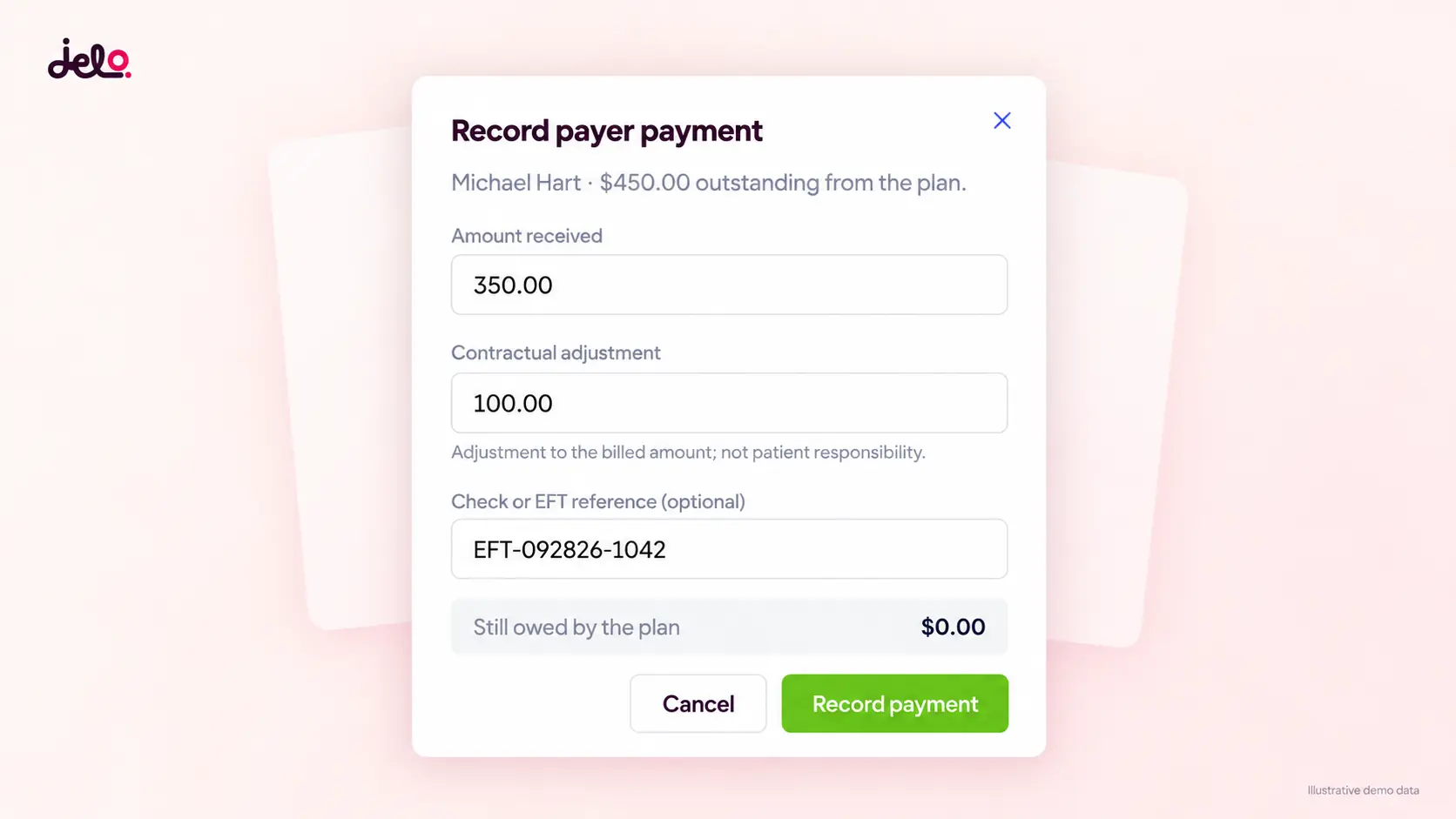
When a payer response includes financial information, the responsible team should match it to the intended claim and review payment, adjustment and remaining balance separately. An adjustment is not money received. A balance should not be assigned or closed merely because a screen can be made to total correctly.
Jelo's payer-remittance form distinguishes payment and contractual adjustment, with a reference and remaining payer balance. Staff should use the actual source amounts and review any suggested adjustment before recording it. The sample interface on the billing page uses fictional amounts and does not represent a posted transaction.
Ask how the practice and service team coordinate a discrepancy. Preserve the source reference and assign the next review rather than changing a number without understanding the cause. Financial reconciliation is a separate acceptance task from confirming that the service can receive an item for review.
Follow unresolved work with a repeatable queue
A queue should identify what remains to be done, not simply collect every old item. Record the source reason, responsible person, next action and next review point. Verify any payer deadline from the appropriate source instead of applying an invented universal interval.
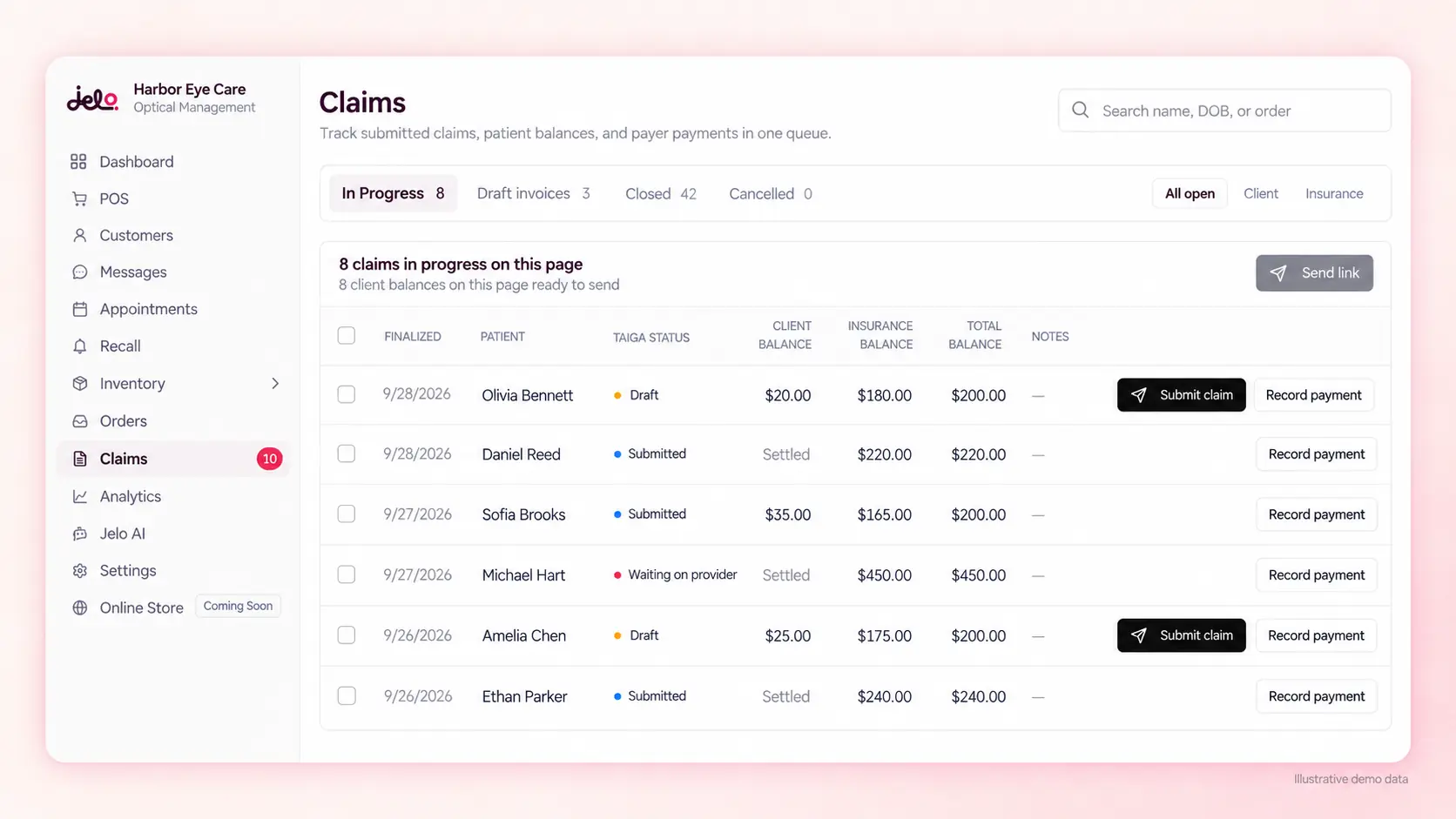
Jelo's claims worklists include drafts, in-progress, closed and cancelled work. Review the status and balance filters with the billing owner so the selected population is understood. A broad status can group items, while the specific next action tells staff how to move one forward.
Use the claim follow-up guide and editable checklist to design the operating review. Keep patient-level information in approved systems. The checklist is a coordination tool, not a promise of automated denial resolution or a replacement for the actual payer response.
Measure the service handoff before judging outcomes
Choose a few process measures that the practice can define and reproduce. Examples include information requests received, requests answered under the agreed rule and unresolved items awaiting a practice action. These counts help identify where coordination needs attention.
Keep reimbursement outcomes separate from task completion. If the practice answers eight of ten eligible information requests, that is an 80% completion rate for the defined task. It does not mean that 80% of claims were paid, that reimbursement increased or that the service caused a financial improvement.
The operations worksheet can calculate aggregate completion rates. For financial performance, agree on the measure, source and period with the appropriate owner. Explain changes in payer mix, volume, staffing and definitions before attributing a result to software or an outside service.
Plan the transition from an existing billing process
If your practice already has open claims or unresolved balances, inventory them before changing workflows. Decide where each category will be worked after the transition and how staff will access the source references. A new service arrangement does not automatically establish that every legacy item has moved into it.
Confirm the data and account scope with the migration and service teams. Review representative examples and identify any work that remains in the previous system or with an existing arrangement. Assign an owner to avoid duplicate requests or items that fall between the old and new processes.
Platform setup takes 3–4 calendar days for a single location and no more than 7 calendar days for multiple locations. Confirm the start date and prerequisites with Jelo during your workflow review. Use the migration checklist to make those prerequisites visible. Insurance readiness should be confirmed before the practice depends on the new workflow for live work.
Coordinate multiple offices deliberately
A multiple-location practice should identify which accounts, staff and operating responsibilities apply to each office. Jelo supports multiple locations, but that does not mean every payer or service arrangement automatically has identical scope across them. Confirm the actual configuration and requirements.
Have staff verify the working office before operational changes. An all-location view can support reporting and review, while edits should use the intended office context. Include a fictional item from each relevant office in the acceptance review if the arrangements differ.
The multiple-location guide helps coordinate access, shared information and office-specific work. Keep the financial reporting basis clear as well: a practice-wide total may be useful, but staff still need to understand which office and source records an unresolved item belongs to.
Review security and access responsibilities
Jelo confirms HIPAA compliance, availability of a BAA, BAAs with providers, an encrypted database and automatic daily backups. These are the published commitments for the platform relationship. If your organization needs additional technical or contractual detail for its review, request it rather than inferring a specific certification or recovery target.
Identify who in the practice can view billing information, respond to a documentation request and approve a financial correction. Test the actual role and office scope. The person covering an absence should understand the task and have the appropriate access, rather than relying on an administrator's account.
Use the security page to organize additional questions. Keep patient records, payer credentials and sensitive financial details within approved systems and transfer processes. General planning documents should describe the workflow and aggregate results without duplicating the underlying private records.
Distinguish the AI biller from other Jelo AI products
The AI biller is the insurance service described here. Jelo AI assistant is the separate in-app practice and exam assistant, available in beta since September 2026. It can prepare supported actions for review and provides clinician-reviewed exam suggestions within its documented scope.
AI scribe and AI receptionist remain planned for the coming months, with no fixed launch dates announced. They should not be treated as available capabilities of the biller or as part of the current service acceptance test. Review product updates when availability is important to the practice's plan.
This distinction helps the team ask better questions. A requirement about patient telephone calls belongs in a receptionist evaluation, while a requirement about a payer response belongs in the insurance service discussion. A shared AI label should not hide different responsibilities, fees or release states.
Leave setup with a reviewable operating agreement
Before relying on the service, summarize the confirmed payer and account scope, the information your practice supplies, the owners of exceptions and the method for reviewing reimbursement and fees. Record any unresolved requirement and the person responsible for obtaining an answer.
Include a realistic rehearsal with a fictional ordinary item and an exception. Have the practice employee who will perform the work explain the next action. The goal is a service handoff that can be operated consistently, including when the usual billing owner is absent.
Book a demo with Joel or Loreli and bring the exact requirements. A useful outcome is a clear division of responsibilities and a confirmed commercial basis. Leave unsupported assumptions out of the launch plan and keep open questions visible until the practice receives a specific answer.